Quick Answer: If your chicken feed is disappearing faster than expected, the most likely culprits are rats, a feeder malfunction, or both. Run a quick checklist — droppings, gnaw marks, and overnight disappearance point to rodents; bridging, overflow, and spillage patterns point to a feeder problem. A systematic diagnosis takes less than 10 minutes and will tell you exactly where to focus.
Unexplained feed loss is one of the most common troubleshooting questions in backyard chicken keeping. You fill the feeder, come back the next morning, and half of it is gone. It’s frustrating — and the answer isn’t always obvious. The question “is it rats or is there an issue with the feeder?” rarely has a clear answer without looking for the right clues, and the tricky part is that both problems can look almost identical at first glance. This guide walks you through a step-by-step diagnosis so you can stop guessing and start fixing.
Is It Rats or a Feeder Problem? Start Here
The Two-Minute Diagnostic
Run through this table first. Tally which column matches what you’re actually seeing in your coop.
| Sign | Rats/Rodents | Feeder Issue |
|---|---|---|
| Feed disappears overnight | ✅ Strong indicator | ✅ Possible (gravity overflow) |
| Droppings near feeder | ✅ Definitive | ❌ Not present |
| Gnaw marks on feeder or wood | ✅ Definitive | ❌ Not present |
| Spillage on coop floor | ✅ Possible | ✅ Very common |
| Feed wet or moldy quickly | ❌ Unlikely | ✅ Classic feeder seal problem |
| Feeder empties unevenly | ❌ Unlikely | ✅ Classic bridging/jamming |
| Wild birds present in coop | ❌ Separate issue | ✅ Often feeder-related |
If you’re seeing droppings, gnaw marks, or burrow holes near the coop — that’s rats, full stop. If feed disappears in a feast-or-famine pattern, or you’re finding floor spillage with no other evidence, a feeder malfunction is the more likely explanation. Work through the steps below to be sure.
Step 1 — Do the Maths: Is Your Feed Actually Disappearing Too Fast?
How Much Should a Chicken Eat Per Day?
Before you panic, establish a baseline. The standard rule is ¼ lb (113g) of feed per bird per day for a standard laying hen. Heavy breeds like Brahmas and Jersey Giants can push up to ⅓ lb (150g) per day, while bantams — Silkies, Sebrights, Dutch Bantams — eat just ⅛ to 3/16 lb (55–85g) per day.
Mixed flocks trip people up constantly. If you keep bantams alongside standard hens, you’re probably overestimating how much the small birds should eat, which makes normal consumption look like a problem.
Calculate Your Flock’s Expected Weekly Consumption
The formula is simple: number of birds × daily amount × 7 days.
For 6 standard hens: 6 × 0.25 lb × 7 = 10.5 lbs per week. A 50 lb bag should last roughly 4–5 weeks. If it’s gone in 2 weeks or less, something else is going on.
Breed Differences Worth Knowing
Active foragers like Leghorns eat efficiently but peck at gravity feeders frequently, which can trigger excess dispensing. Heavier scratchers — Rhode Island Reds, Australorps, Barred Plymouth Rocks — tend to push feed out of troughs. Dominant hens in any breed can monopolize the feeder, causing subordinate birds to scratch aggressively at the base. That floor spillage adds up fast.
Seasonal and Lifecycle Spikes That Look Like Feed Loss
Several normal situations cause legitimate consumption increases:
- Flock coming back into lay: 15–20% more feed
- Pullets transitioning at 18–24 weeks: 10–15% more feed
- Cold weather: 10–15% more feed as hens burn calories staying warm
- New birds integrating: another 10–15% bump during pecking order establishment
- Broody hens: eat up to 50% less — if one hen goes broody and overall consumption drops noticeably, that’s completely normal
If consumption spikes in winter, that’s expected. If it spikes in mild weather with no other changes, keep reading.
Step 2 — Spot the Signs of Rats
Definitive Evidence of Rodent Activity
Any one of these is enough to confirm you have a rodent problem:
- Droppings — dark, pellet-shaped, typically found near the feeder, along walls, or near storage containers
- Gnaw marks — on wood, plastic feeders, storage bin lids, or coop framing
- Burrow holes — along the coop perimeter, under the run, or near feed storage
- Feed disappearing overnight — rats are nocturnal; if the feeder is full at dusk and half-empty at dawn with no other explanation, that’s a strong indicator
How Rats Get In and Why They Stay
Rats exploit ground-level feeders immediately — if the tray is within reach, it’s an open buffet. They’ll chew through plastic storage bins in under 48 hours. Scattered scratch grains left on the ground overnight are an even easier target. Once rats find a reliable food source, they establish regular routes and bring others.
The top attractants are mash feed (the most aromatic feed form), wet scraps left in the coop overnight, and open ground-level troughs. A coop with poor feed management is essentially a restaurant with no closing time.
The Health Risk to Your Flock
This isn’t just a nuisance. Rats carry Salmonella, which contaminates feed and water and transmits directly to your birds. Leptospirosis spreads through rat urine in water and feed sources. Rats and the wild birds they attract can also introduce mites, lice, and respiratory pathogens including Mycoplasma. Rodent control is a genuine biosecurity priority, not just housekeeping.
Step 3 — Diagnose Your Feeder for Malfunctions
Bridging: When Feed Clumps and Then Floods
Bridging is one of the most misdiagnosed problems in chicken keeping. Moisture or fine-ground feed causes particles to clump inside the tube, blocking flow entirely. The feeder appears to empty slowly — until the bridge collapses and releases a large amount all at once. That sudden dump creates a pile on the tray that gets scratched onto the floor and disappears, mimicking overnight rodent activity almost perfectly.
High humidity (above 70%) is the main trigger. Mash bridges far more readily than pellets.
Overflow Dispensing and Worn Feeder Gaps
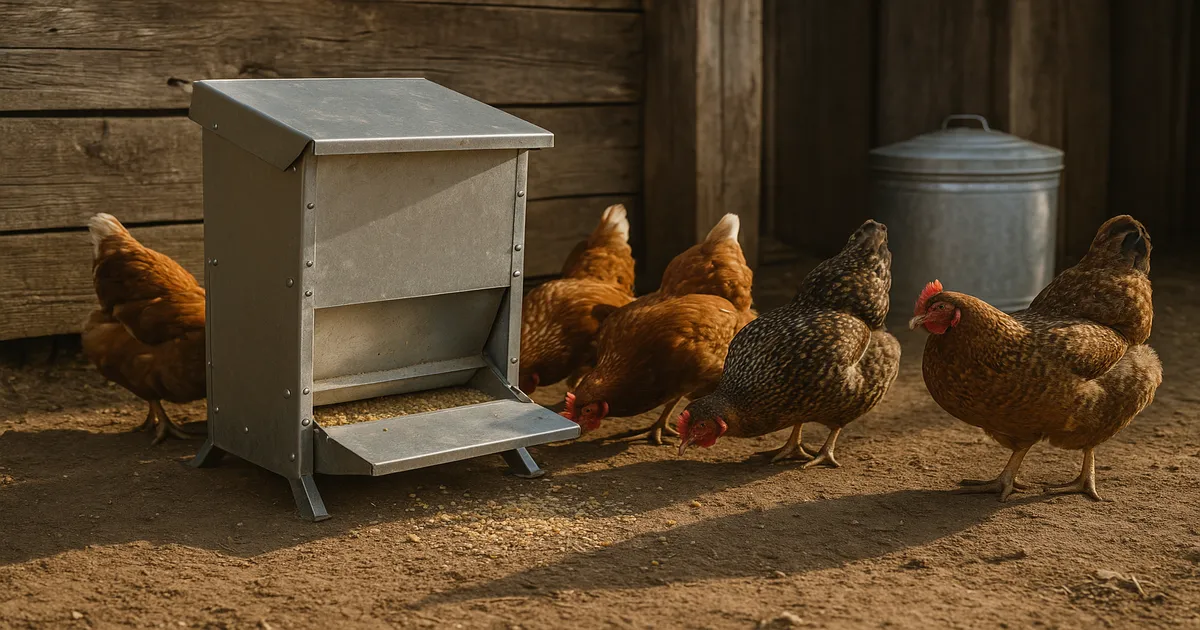
Gravity feeders have a dispensing gap between the tube and the tray. The correct gap for standard pellets is 3/8 to ½ inch. If the gap is worn wider — or was set incorrectly from the start — the feeder releases too much feed with every peck, and the excess ends up on the floor. Check your feeder’s gap size. It’s a two-minute fix that can eliminate a significant amount of waste.
Swing Spillage From Hanging Feeders
A hanging feeder that swings freely spills feed with every peck. Hens hit it, it swings, pellets fly out, and within a day the bedding is full of wasted feed. Adding a stabilizer cord or switching to a wall-mounted design eliminates this entirely. A stabilizer kit paired with a quality hanging feeder — such as the Little Giant Hanging Poultry Feeder — is an inexpensive fix that pays for itself quickly.
Incorrect Feeder Height
Feeder height is the single biggest driver of spillage that most keepers overlook. Standard breeds need the feeder tray at 6–8 inches off the ground — roughly at back height. Bantams need 4–5 inches. Too low, and hens scratch feed out constantly. Too high, and smaller or younger birds can’t reach properly and make a mess trying.
Feeder Type Comparison
| Feeder Type | Waste Level | Rat Risk |
|---|---|---|
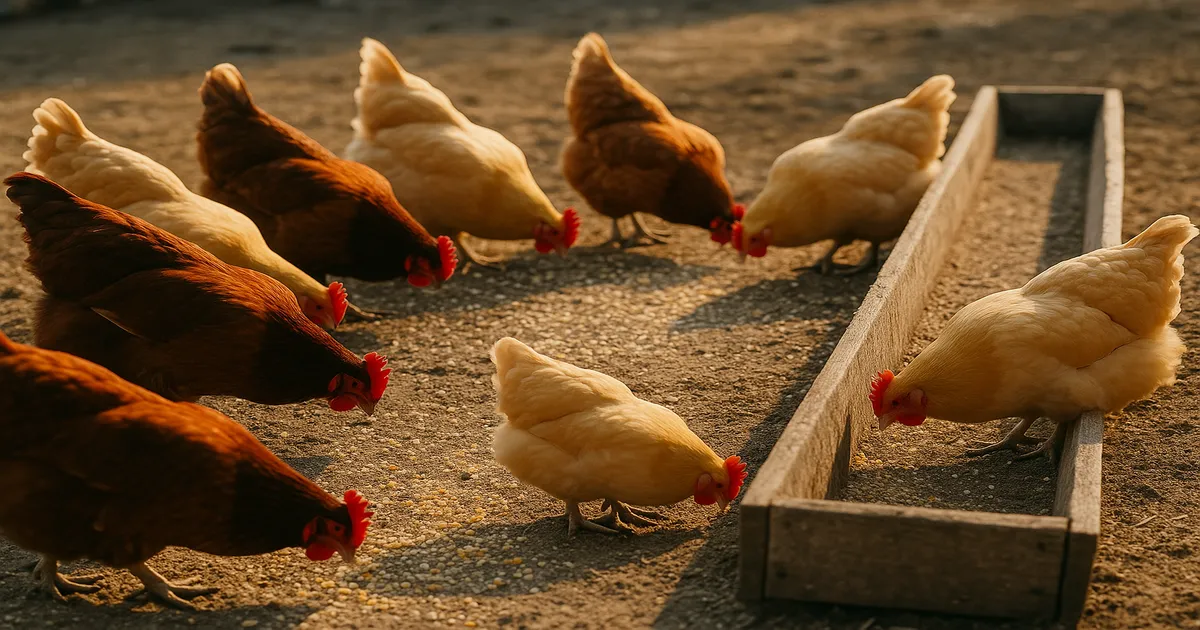
| Open trough | High | High |
| Tube gravity feeder | Medium | Medium |
| Hanging tube | Medium | Medium |
| Treadle/step feeder | Very Low | Very Low |
Step 4 — Check Feeder Placement and Coop Setup
Never place a feeder directly on the ground. Ground-level feeders get contaminated with droppings, shavings, and moisture — hens reject fouled feed and waste even more. Keep feeders away from roost bars too; hens roosting above the feeder will contaminate it overnight.
Maintain at least 12 inches of linear feeder space per bird. When birds crowd and compete, spillage increases dramatically. If your coop is below the recommended 4 sq ft per standard bird indoors (10 sq ft per bird in the run), competition at the feeder will be constant. Adding a second feeding station is often the fastest fix for tight setups.
Open feeder designs also attract sparrows and starlings, which can carry Avian Influenza and Mycoplasma. If wild birds are getting into your coop, switch to an enclosed feeder design and eliminate any ground-level food sources immediately.
Feed Type and Storage: Cutting Waste and Rodent Risk Together
Pellets vs. Crumble vs. Mash
Pellets are the clear winner for waste reduction. They’re harder for rodents to carry away, less aromatic, and far less prone to bridging. Mash is at the opposite end — fine particles fall through feeder gaps easily, it’s the most attractive feed form to rodents, and it bridges constantly in tube feeders. Crumble sits in the middle on all counts. If you’re currently feeding mash and struggling with waste or rodents, switching to pellets is one of the highest-impact changes you can make.
Scratch Grains and the 10% Rule
Treats should make up no more than 10% of your flock’s total diet. More importantly, never scatter more scratch grains than your hens will clean up in 15–20 minutes. Leftover scratch on the ground overnight is one of the top rat attractants — it’s essentially bait. Remove uneaten treats within 20–30 minutes, every time.
Store Feed So Rats Cannot Get to It
Metal containers with locking lids are the gold standard for feed storage. A heavy-gauge steel can — such as the Behrens Locking Steel Can — is the most reliable option available. Rats chew through plastic bins in under 48 hours. Store feed outside the coop in a separate sealed area. Feed stored inside the coop is an open invitation for nightly rodent visits, regardless of how good your feeder is.
Prevention and Long-Term Solutions
Rat-Proofing Your Coop
Hardware cloth with ½-inch openings is the correct material for sealing gaps — standard chicken wire has openings large enough for juvenile rats to squeeze through. Bury an apron of hardware cloth 12 inches deep and 12 inches outward around the coop perimeter to prevent burrowing. Seal any gap larger than ½ inch in the coop structure itself.
Upgrading to a Treadle Feeder
A treadle feeder — one that only opens when a chicken steps on the platform — is the most effective combined solution for both waste and rodent control. Rats and wild birds can’t trigger the mechanism, and waste drops to near zero because feed is only accessible when a bird is actively eating. Grandpa’s Feeders Automatic Chicken Feeder is the most widely recommended option and holds up well in all weather conditions. There’s a training period of 1–2 weeks while your hens learn to use it, but most keepers say it’s the best upgrade they’ve made.
Nightly Cleanup Routine
Rats are nocturnal. Everything you do before dusk matters more than anything you do during the day.
- Remove uneaten treats and wet scraps within 20–30 minutes of offering them
- Sweep up floor spillage before dusk — don’t leave it for morning
- If you have an active infestation, pull feeders inside or into a secure container overnight until the problem is under control
Monthly Feeder Maintenance Checklist
Run through this once a month:
- Inspect feeder body and lid for gnaw marks
- Check dispensing gap size (3/8–½ inch for standard pellets)
- Test hanging feeder for swing; tighten or add stabilizer if needed
- Clean interior for mold, moisture residue, or bridged feed
- Confirm feeder height is correct for your flock’s current size
- Check storage container lids for damage or gaps
Frequently Asked Questions
Is it rats or a feeder issue — how can I tell for sure?
Look for droppings (dark, pellet-shaped), gnaw marks on wood or plastic, and burrow holes around the coop perimeter. Feed disappearing specifically between dusk and dawn is another strong indicator of rats. Feeder malfunctions — bridging, overflow, swing spillage — can produce very similar overnight disappearance, but they won’t leave droppings or gnaw marks. If you see any of those physical signs, rodents are involved regardless of what the feeder is doing.
Why is my chicken feeder emptying so fast?
The most common culprits are bridging (feed clumps and then releases all at once), an oversized dispensing gap causing overflow, a feeder hung at the wrong height causing scratching losses, or a flock coming back into lay after a rest period. Cold weather also drives a 10–15% increase in consumption that catches many keepers off guard. Work through the feeder malfunction checks in Step 3 before assuming rodents.
What is the best rat-proof chicken feeder?
A treadle feeder is the gold standard — the lid only opens when a chicken steps on the platform, making it inaccessible to rats and wild birds. For a mid-range option, enclosed gravity feeders with tight-fitting lids significantly reduce rodent access compared to open troughs or standard hanging tubes. Pair either type with proper metal feed storage and a nightly cleanup routine for the best results.
How much feed should 6 chickens eat per week?
Six standard laying hens should consume approximately 10.5 lbs of feed per week (6 birds × ¼ lb per day × 7 days). If you’re going through significantly more than this — especially if a 50 lb bag disappears in under 2 weeks — investigate feeders, spillage, rodents, or wild bird intrusion. Bantams eat roughly half as much, so adjust the formula if you have a mixed flock.
Can a feeder malfunction really look like a rat problem?
Yes. Bridging is the closest mimic — feed stops flowing, then releases a large amount all at once, creating a pile that gets scratched onto the floor and disappears overnight. Overflow dispensing from a worn feeder gap produces a similar pattern. The key difference is physical evidence: feeder malfunctions won’t produce droppings, gnaw marks, or burrow holes. If you’re seeing any of those, rodents are involved.